Research and Education Networks (R&E) are interconnected on a global scale through a system of National Research and Education Networks (NRENs), regional networks, and global platforms that work together to create an integrated digital infrastructure. Each NREN represents the backbone for research and educational institutions within its respective country, providing them with high-speed connectivity, security, and the technical support needed for academic and research activities. These NRENs are then interconnected with other national and regional networks to form a Global Research and Education Network, which allows institutions worldwide to collaborate, share data, and engage in research and educational activities across borders.
The primary objective of the global R&E network is to create a seamless communication and collaboration environment for researchers, educators, and students. By connecting institutions around the world, it facilitates the exchange of knowledge, research, and resources, making it possible for academics to access and contribute to global research projects in real time. This interconnected system allows users to leverage cutting-edge resources like supercomputing facilities, specialized databases, and collaborative research platforms that may not be available locally. Through these global connections, R&E institutions can work together on complex, multidisciplinary projects such as climate change research, global health initiatives, and innovations in technology.c collaboration, scientific research, and digital initiatives. It plays a crucial role in enabling cross-border research projects, including e-health, environmental monitoring, disaster response, and artificial intelligence advancements.
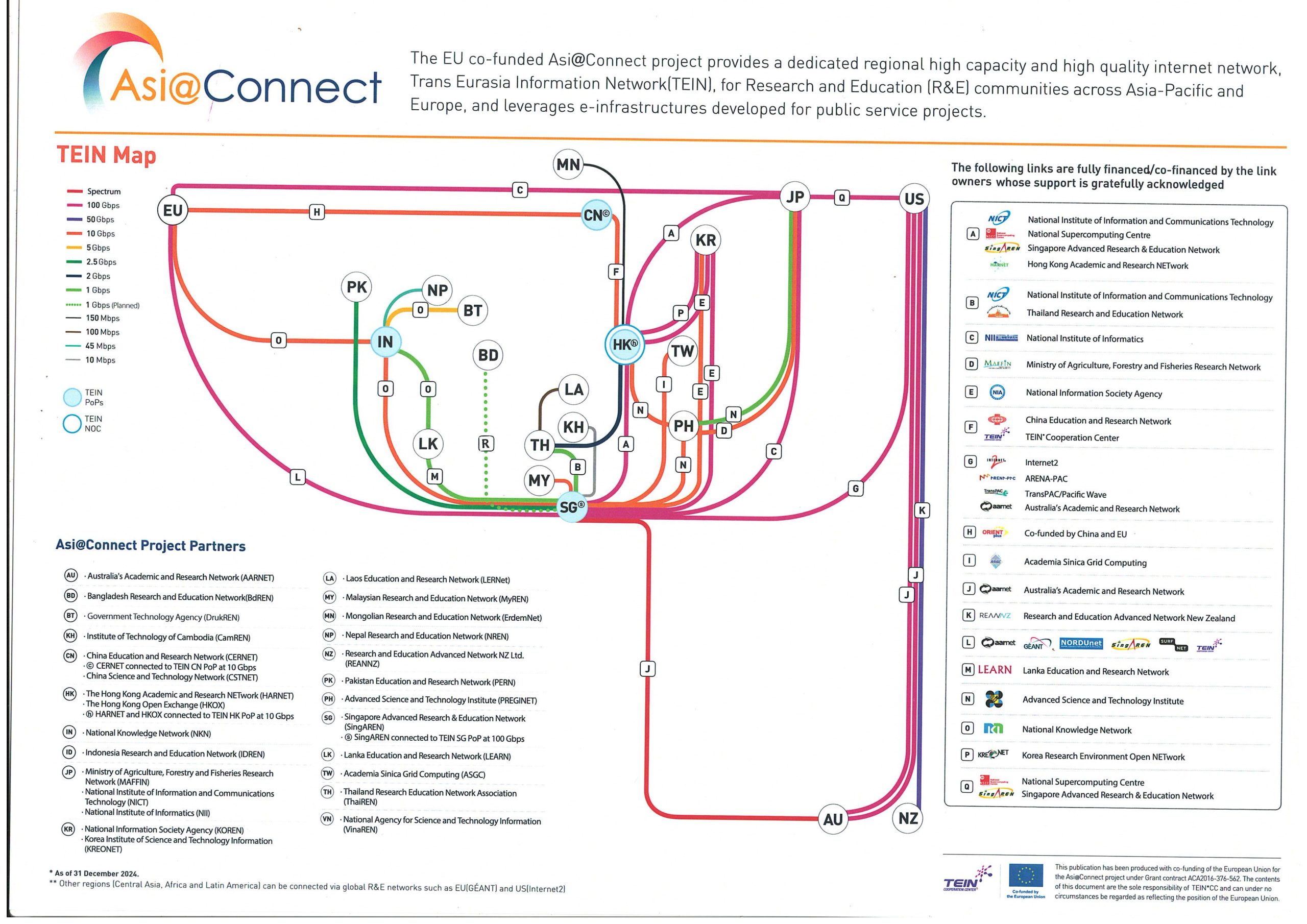
One significant part of this global network is the Trans-Eurasia Information Network (TEIN), which connects Asia-Pacific’s research and education communities with their counterparts in Europe and beyond. TEIN, co-funded by the European Union under the Asi@Connect project, provides high-capacity, high-quality internet connectivity to support academic collaboration, scientific research, and digital initiatives. It plays a crucial role in enabling cross-border research projects, including e-health, environmental monitoring, disaster response, and artificial intelligence advancements.
The TEIN Map visually represents the network infrastructure, showing the interconnections between different NRENs and their bandwidth capacities across the region. The map highlights key connectivity points, major links, and funding sources that sustain this international research and education collaboration. With TEIN’s expanding network, institutions in the Asia-Pacific region gain enhanced access to global research facilities, fostering innovation and strengthening the global research community.